quinta-feira, 24 de maio de 2012


sábado, 19 de maio de 2012
Hamlet and The Kronborg Castle
Hamlet story by William Shakespeare takes place at Elsinore Castle, known nowadays as Kronborg Castle. It is the setting where the young prince sees the ghost of his father and starts his search for truth and an imminent revenge. The link below takes you to a video which reveals more about this historical castle providing you visual details of a legendary place.
terça-feira, 1 de maio de 2012
Why do we yawn?
Article and images extracted from: http://faculty.washington.edu/chudler/yawning.html accessed May1,2012.
Yawning... And Why Yawns Are Contagious
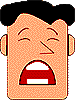 Before you read any more of this page, get a pencil (or
pen) and paper.
Before you read any more of this page, get a pencil (or
pen) and paper.
I will wait...I'm still waiting...Did you get it? Good!
 With your
pencil and paper, keep track of the number of times you yawn while you are
reading this page. I hope reading this page is not boring, but you may
find that just thinking and reading about yawning makes you yawn. The
results may surprise you. Did you yawn yet? If you did, make sure you
count it.
With your
pencil and paper, keep track of the number of times you yawn while you are
reading this page. I hope reading this page is not boring, but you may
find that just thinking and reading about yawning makes you yawn. The
results may surprise you. Did you yawn yet? If you did, make sure you
count it.
Everyone yawns - babies, kids, teenagers, adults. Some birds, reptiles
and most mammals also yawn. However, the reason why we yawn is a bit of a
mystery. There is also very little research about yawning because for
most people yawning is not a problem. Here are a few things that are
known about yawns:
- The average duration of a yawn is about 6 seconds.
- In humans, the earliest occurrence of a yawn happens at about 11 weeks after conception - that's BEFORE the baby is born!
- Yawns become contagious to people between the first and second years of life.
- A part of the brain that plays an important role in yawning is the hypothalamus. Research has shown that some neurotransmitters (for example, dopamine, excitatory amino acids, nitric oxide) and neuropeptides increase yawning if injected into the hypothalamus of animals.


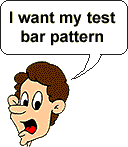 You know that when you are bored, you yawn. Scientists have confirmed
this observation by comparing the number of yawns in 17-19 year old
students who watched music videos to the number of yawns in students who
watched an uninteresting color test bar pattern.
You know that when you are bored, you yawn. Scientists have confirmed
this observation by comparing the number of yawns in 17-19 year old
students who watched music videos to the number of yawns in students who
watched an uninteresting color test bar pattern.
As you might have expected, people who watched the color test bar
pattern yawned more (5.78 yawns in 30 minutes) than those who watched the
"MTV-like" video (3.41 yawns in 30 minutes.) The average duration of
yawns was also slightly longer in the test bar viewing group. One
unexpected finding was that yawns in male students had a longer duration
than those in female students.
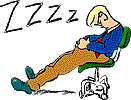 Many people assume that we
yawn because our bodies are trying to get rid of extra carbon dioxide and
to take in more oxygen. This may make some sense. According to this
theory, when people are bored or tired, they breathe more slowly. As
breathing slows down, less oxygen makes it to the lungs. As carbon
dioxide builds up in the blood, a message to the brain results in signals
back to the lungs saying, "Take a deep breath," and a yawn is
produced.
Many people assume that we
yawn because our bodies are trying to get rid of extra carbon dioxide and
to take in more oxygen. This may make some sense. According to this
theory, when people are bored or tired, they breathe more slowly. As
breathing slows down, less oxygen makes it to the lungs. As carbon
dioxide builds up in the blood, a message to the brain results in signals
back to the lungs saying, "Take a deep breath," and a yawn is
produced.
The only problem with the excess carbon dioxide theory is that research
shows that it may not be true. In 1987, Dr. Robert Provine and his
coworkers set up an experiment to test the theory that high carbon
dioxide/low oxygen blood content causes yawning. Air is normally made up
of 20.95% oxygen, 79.02% nitrogen, 0.03% carbon dioxide and a few other
gases in low concentrations. The researchers gave college students the
following gases to breathe for 30 minutes:
 Gas #1 = 100% Oxygen
Gas #2 = 3% Carbon dioxide, 21% Oxygen
Gas #3 = 5% Carbon dioxide, 21% Oxygen
Gas #4 = Normal Air
Breathing 100% oxygen (Gas #1) or either carbon dioxide gas (Gas #2 and
#3) did cause the students to breathe at a faster rate. However, neither
carbon dixoide gas nor 100% oxygen caused the students to yawn more.
These gases also did not change the duration of yawns when they
occurred.
The researchers also looked for a relationship between breathing and
yawning by having people exercise. Exercise, obviously, causes people to
breathe faster. However, the number of yawns during exercise was not
different from the number of yawns before or after exercise. Therefore,
it appears that yawning is not due to CO2/O2 levels
in the blood and that yawning and breathing are controlled by different
mechanisms.
So, the question remains - why do we yawn? Dr. Provine suggests that
perhaps yawning is like stretching. Yawning and stretching increase blood
pressure and heart rate and also flex muscles and joints. Evidence that
yawning and stretching may be related comes from the observation that if
you try to stifle or prevent a yawn by clenching your jaws shut, the yawn
is somewhat "unsatisfying." For some reason, the stretching of jaw and
face muscles is necessary for a good yawn.
In 2007, researchers proposed that yawning is used to cool the brain.
They found that people yawned more often they pressed a warm or room
temperature towel against their heads than when they pressed a cold towel
against their heads. People who breathed through their noses (thought
to reduce brain temperature) did not yawn at all.
It is possible that yawns are contagious because at one time in
evolutionary history, the yawn served to coordinate the social behavior of
a group of animals. When one member of the group yawned to signal an
event, all the other members of the group also yawned. Yawns may still be
contagious these days because of a leftover response (a "vestigial"
response) that is not used anymore. None of this has been proven true and
yawns are still one of the mysteries of the mind.

So, how many times did you yawn?

Still interested in yawns? Try an experiment
to keep track of your own yawning.
Did you know?
Here's a new vocabulary word for you: pandiculation.
Pandiculation is the act of stretching and yawning.

They said it!
 A yawn is quite catching you see. Like a cough.
It just takes one yawn to start other yawns off."
--- Dr. Seuss (in Dr. Seuss's Sleep Book, New York: Random House, 1962.)
References and further information:
- Contagious Yawning, Those who feel for others catch yawns. - Neuroscience for Kids
- Provine, R.R. Contagious yawning and infant imitation. Bulletin Psychonomic Soc., 27:125-126, 1989.
- Provine, R.R. Yawning: effects of stimulus interest. Bulletin Psychonomic Soc., 24:437-438, 1986.
- Provine, R.R. Faces as releasers of contagious yawning: an approach to face detection using normal human subjects. Bulletin Psychonomic Soc., 27:211-214, 1989.
- Provine, R.R. Yawning as a stereotyped action pattern and releasing stimulus. Ethology, 72:109-122, 1986.
- Provine, R.R., Hamernik, H.B. and Curchack, B.B. Yawning: relation to sleeping and stretching in humans. Ethology, 76:152-160, 1987.
- The neuropharmacology of yawning
- Yawning: no effect of 3-5% CO2, 100% O2, and exercise
- What Makes Us Yawn - from How Stuff Works
- Gallup, A.C. and Gallup, G.G., Yawning as a brain cooling mechanism: Nasal breathing and forehead cooling diminish the incidence of contagious yawning, Evolutionary Psychology, 5:92-101, 2007.
Assinar:
Postagens (Atom)
-
Article and images extracted from: http://faculty.washington.edu/chudler/yawning.html accessed May1,2012. Yawning... And Why Yawns Ar...
-
http://www.grammarly.com/?q=grammar&gclid=CPfG7diW0LYCFQWCnQod9GsAMg
